
Last updated September 20, 2026
Free on-site gate assessment - hinges, posts, and your LiftMaster or Nice gate operator checked before anything is quoted
The assessment is free and the quote is the invoice.
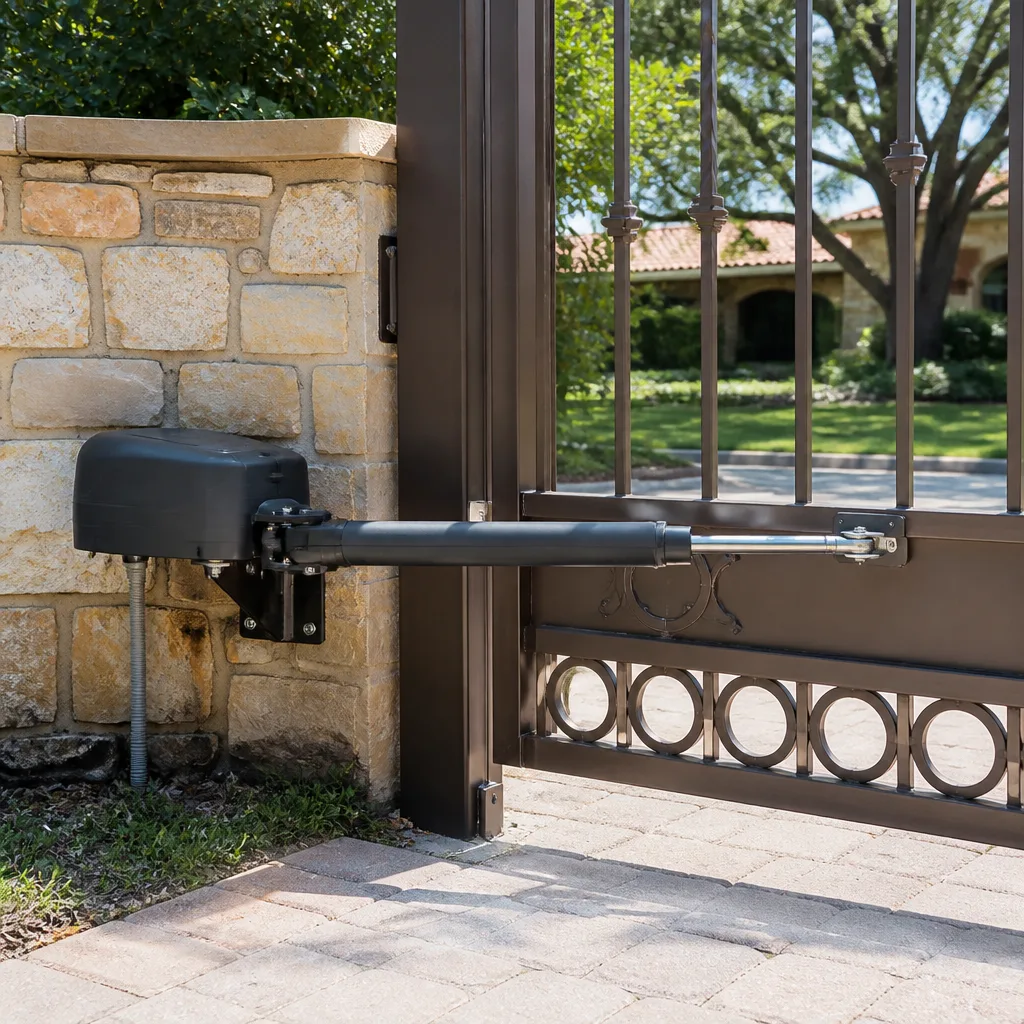
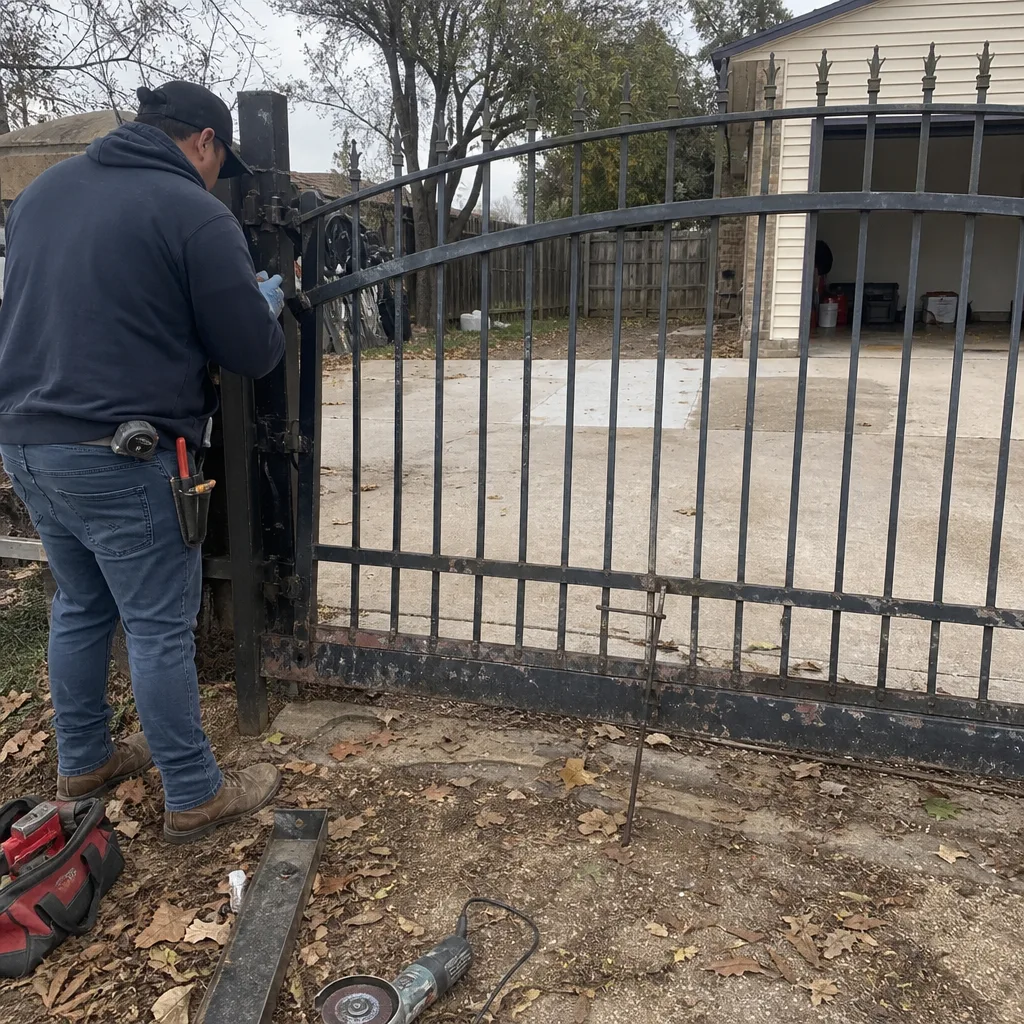 Before
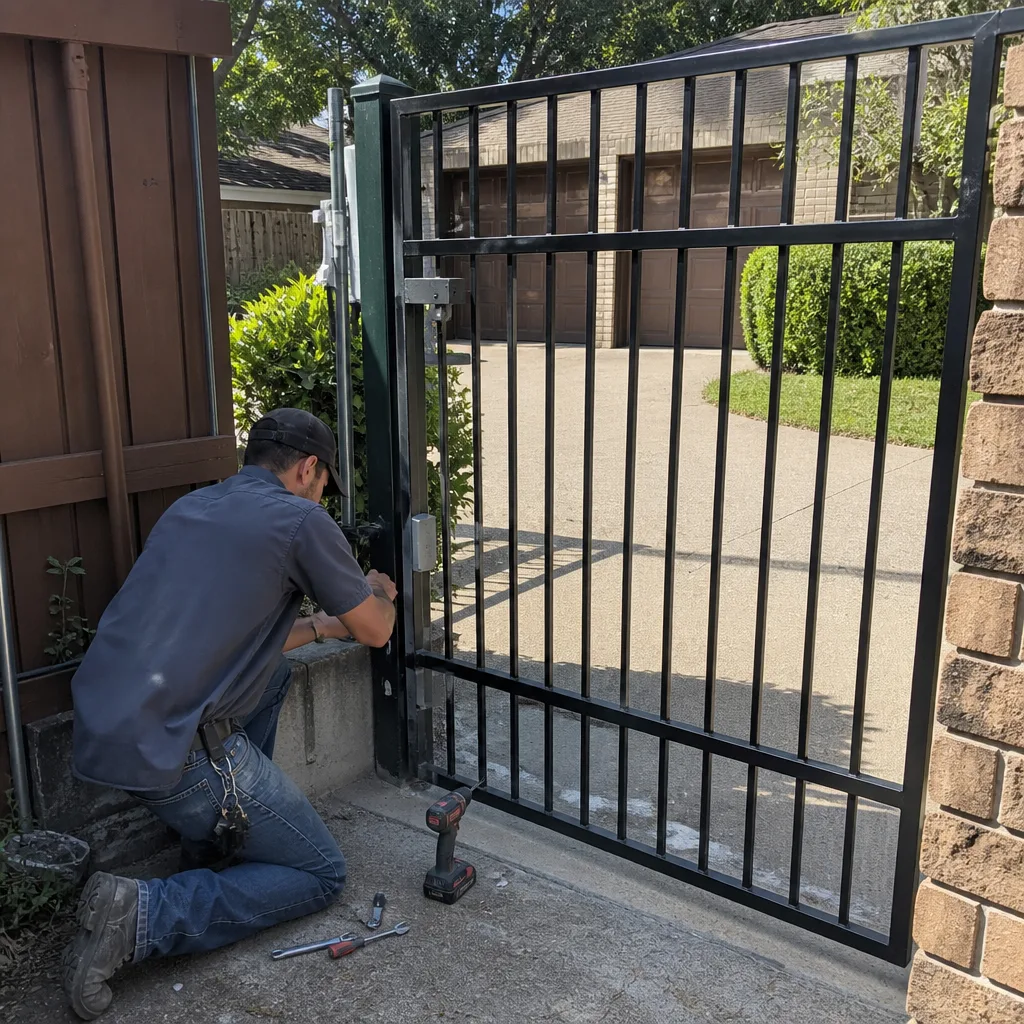 After
After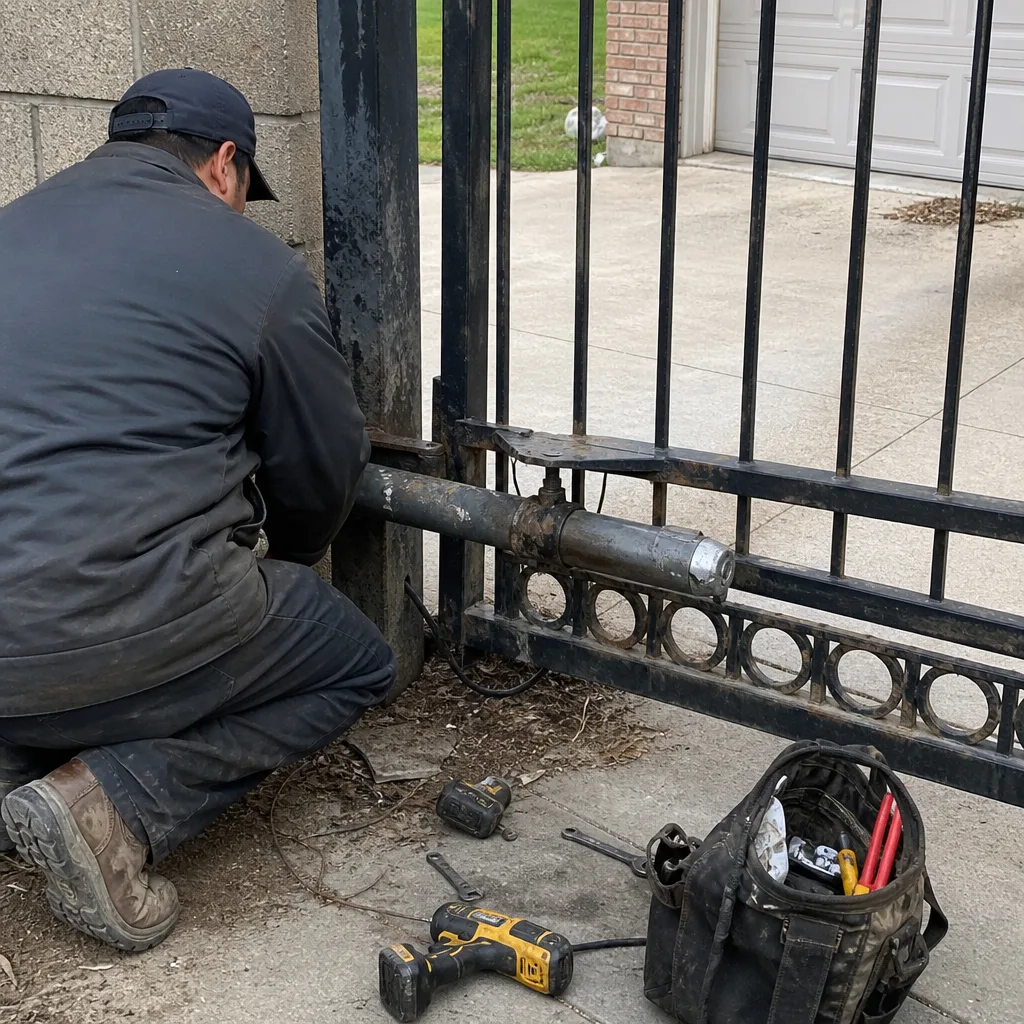 Before
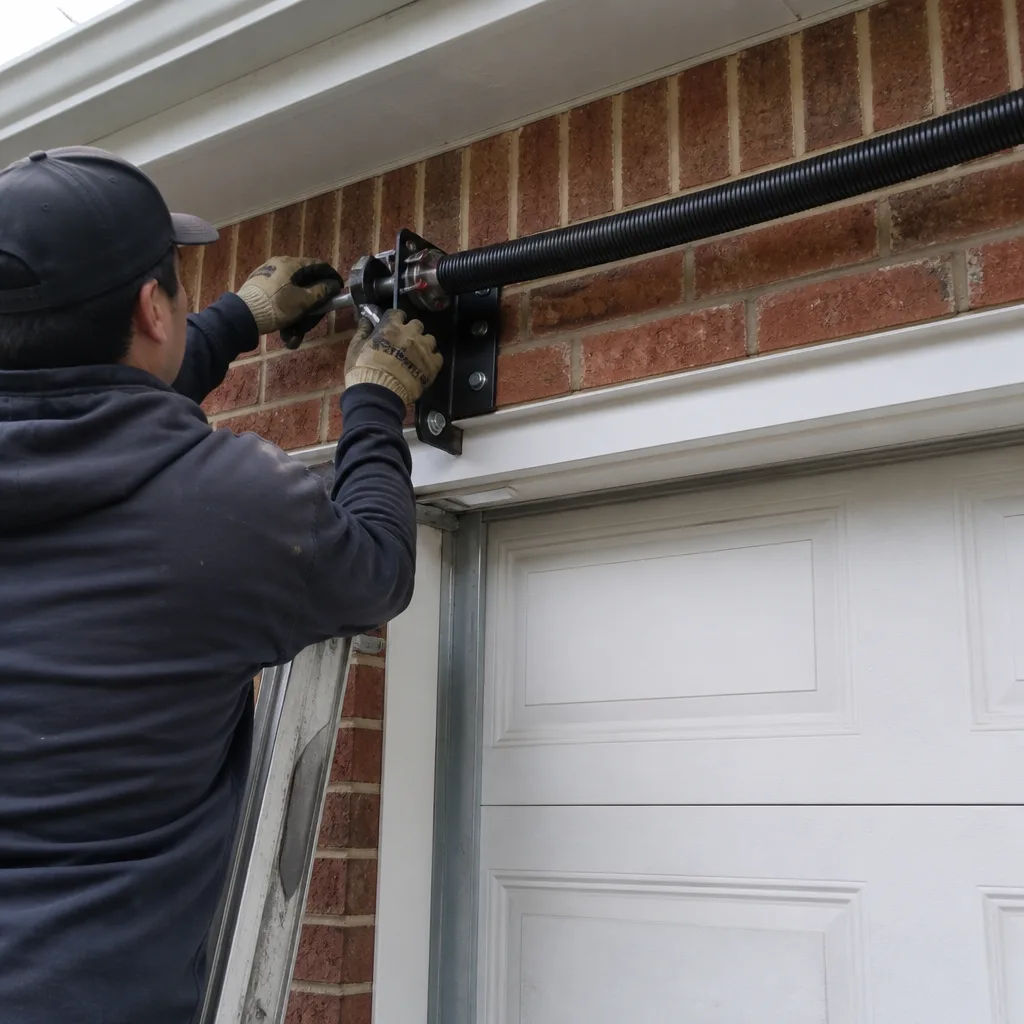 After
After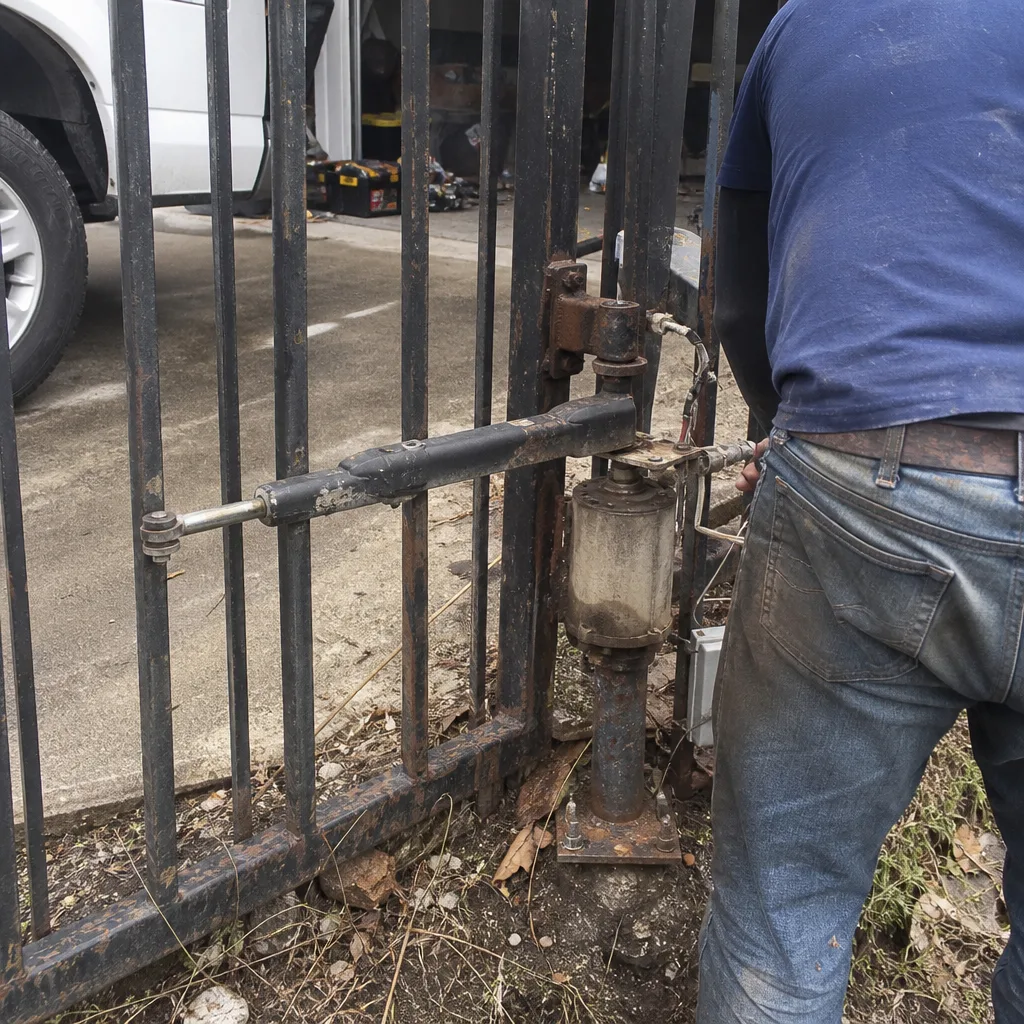 Before
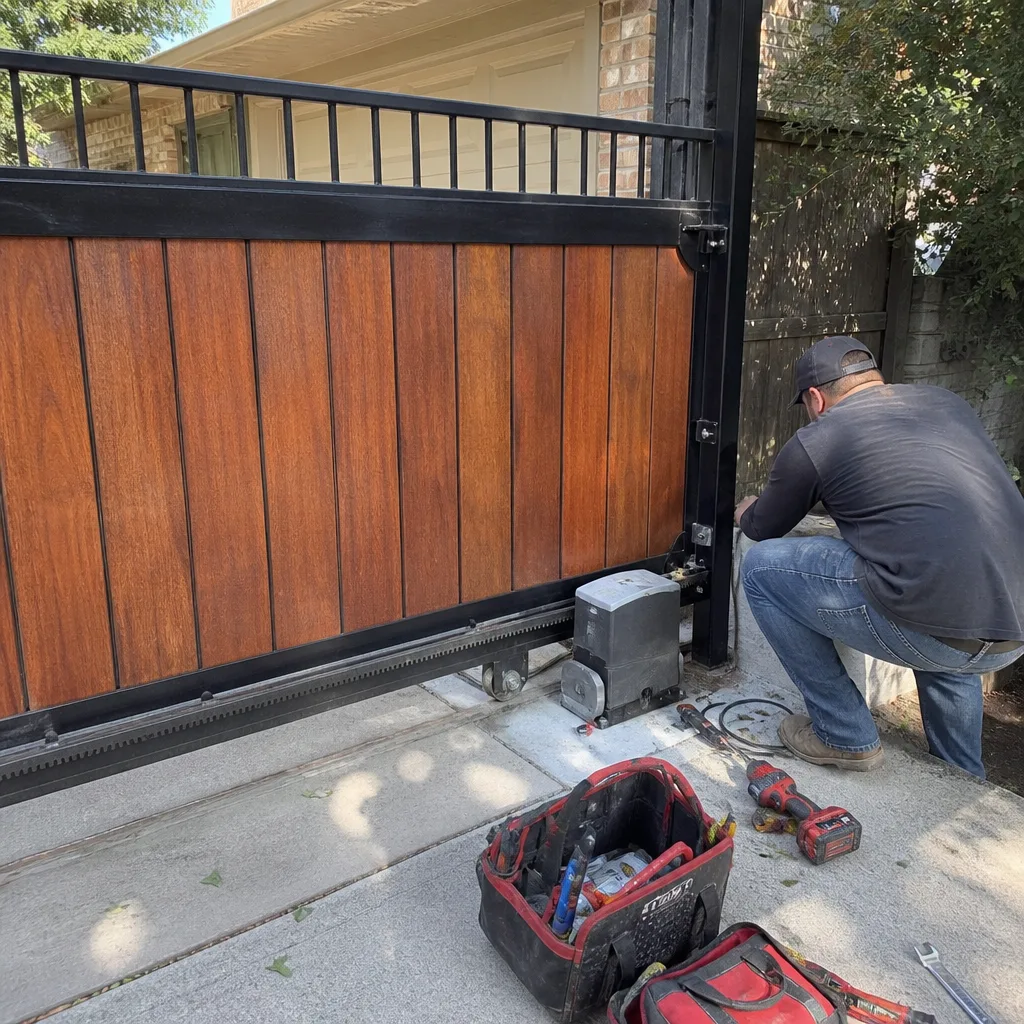 After
AfterSeasonal Gate Repair Care for Garland: Year-Round Homeowner’s Guide
The February 2021 freeze didn’t just knock out power across Garland. It cracked gate posts, sheared weld points, and twisted hinge brackets on properties throughout the city. The failure pattern that week was remarkably consistent: gates that had quietly shifted during the previous summer’s drought snapped the moment frozen ground expanded against their posts. One season’s neglect set up the next season’s failure. This guide covers how Garland’s climate stresses gate systems in predictable seasonal patterns, what to check each quarter, and when to call a gate repair technician who will document what they find.
Quick Answer
Seasonal gate care in Garland means matching maintenance to the failure mode each quarter actually produces: summer heat kills operator electronics, fall is your only window to re-align posts after soil shrinkage, winter freezes attack mechanical anchors and hydraulics, and spring is storm-preparation season for photoeyes and battery backups. A quarterly inspection with photo documentation prevents the cascading pattern where one season’s unnoticed movement becomes the next season’s broken gate.
Table of Contents
- Summer (June-September): Heat, Capacitors, and Slide Gate Operators
- Fall (October-November): The Post-Re-Alignment Window
- Winter (December-February): Freeze Protocols and Hydraulic Systems
- Spring (March-May): Storm Prep, Photoeyes, and Battery Backup
- How to Build a Seasonal Gate Log That Shows Degradation Over Time
- Which Components Fail in Which Season in Garland
- Common Mistakes to Avoid
- When to Call a Professional
- Frequently Asked Questions
- The Bottom Line
BeforeAfterSummer (June-September): Heat, Capacitors, and Slide Gate Operators
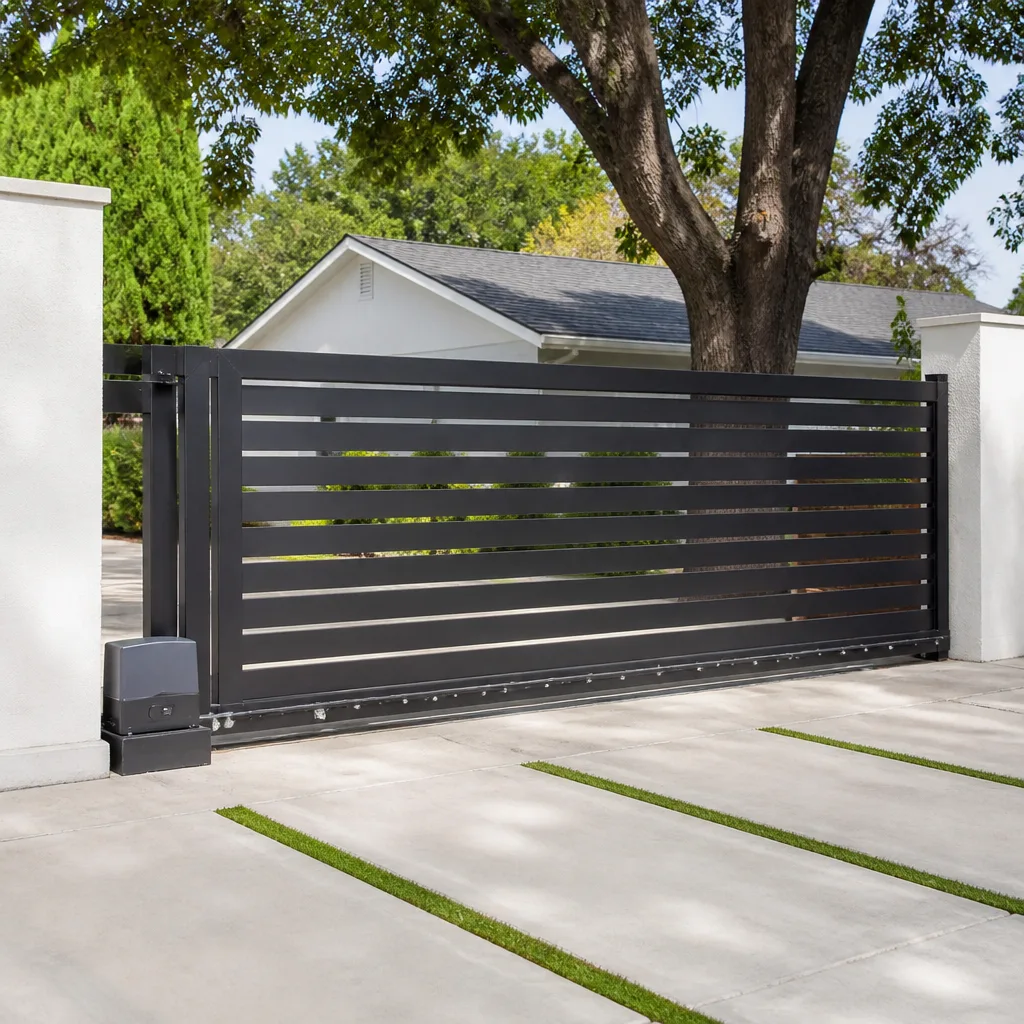
Garland regularly sees ambient temperatures above 100°F from mid-June through early September. Inside a metal operator housing mounted on a black iron gate, internal temperatures can exceed 140°F. The component that fails first is the capacitor, the cylinder-shaped part that provides the starting torque to move the gate. Capacitors are electrolytic, which means they contain a liquid electrolyte that degrades faster as heat rises. We’ve pulled capacitors out of slide gate operators in Garland in mid-August that felt hot to the touch an hour after the gate stopped working.
The warning symptoms of heat-stressed capacitors are specific:
- The gate starts slower than usual, especially in the late afternoon when the day’s heat has peaked.
- The motor hums for half a second before the gate begins moving.
- The gate operates normally in the morning but labors or stalls after 3 p.m.
- You hear a soft clicking from the operator housing when you trigger the remote.
This cluster of symptoms points to a capacitor losing its ability to hold and discharge starting voltage. It’s a $40 to $120 part depending on the operator brand. If caught early, the fix takes under an hour. If ignored, the failed capacitor forces the motor to draw more current, which burns out the windings, as detailed in DIY vs Professional Gate Repair: The Garland Homeowner’s Decision Guide. That’s the difference between replacing a capacitor and replacing the entire operator, which for most slide systems in Garland runs $1,100 to $2,700 including labor.
Other summer-specific checks for Garland homeowners:
- Verify the cooling fan inside the operator housing runs. Many slide gate operators have a small ventilation fan. If it stopped over the winter, the housing overheats every afternoon in July. This is a visible, mechanical check you can do yourself by opening the housing cover and watching for fan movement when the gate cycles.
- Check the internal battery, not just the motor. Heat accelerates battery discharge. A backup battery that’s five years old will fail faster during a Garland summer than during a mild northern winter. Test it once in June and once in September.
- Lubricate the track and rollers in the morning, not the afternoon. Metal expands in heat. Applying lubricant when the track is at its hottest locks in whatever micro-alignment exists at that moment. Do it at 7 a.m. when the metal has cooled overnight and gaps are at their widest.
If your slide gate operator is a LiftMaster or BFT model, the heat will eventually degrade the control board as well. We see it as often as capacitors. The symptom is random behavior: the gate stops mid-travel, reverses unexpectedly, or ignores the remote for ten seconds and then responds. Board replacements are more expensive than capacitors but still cheaper than a full operator swap. For a deeper look at how operator electronics behave in Garland’s heat, see our Gate Motor & Opener in Garland page.
Fall (October-November): The Post-Re-Alignment Window
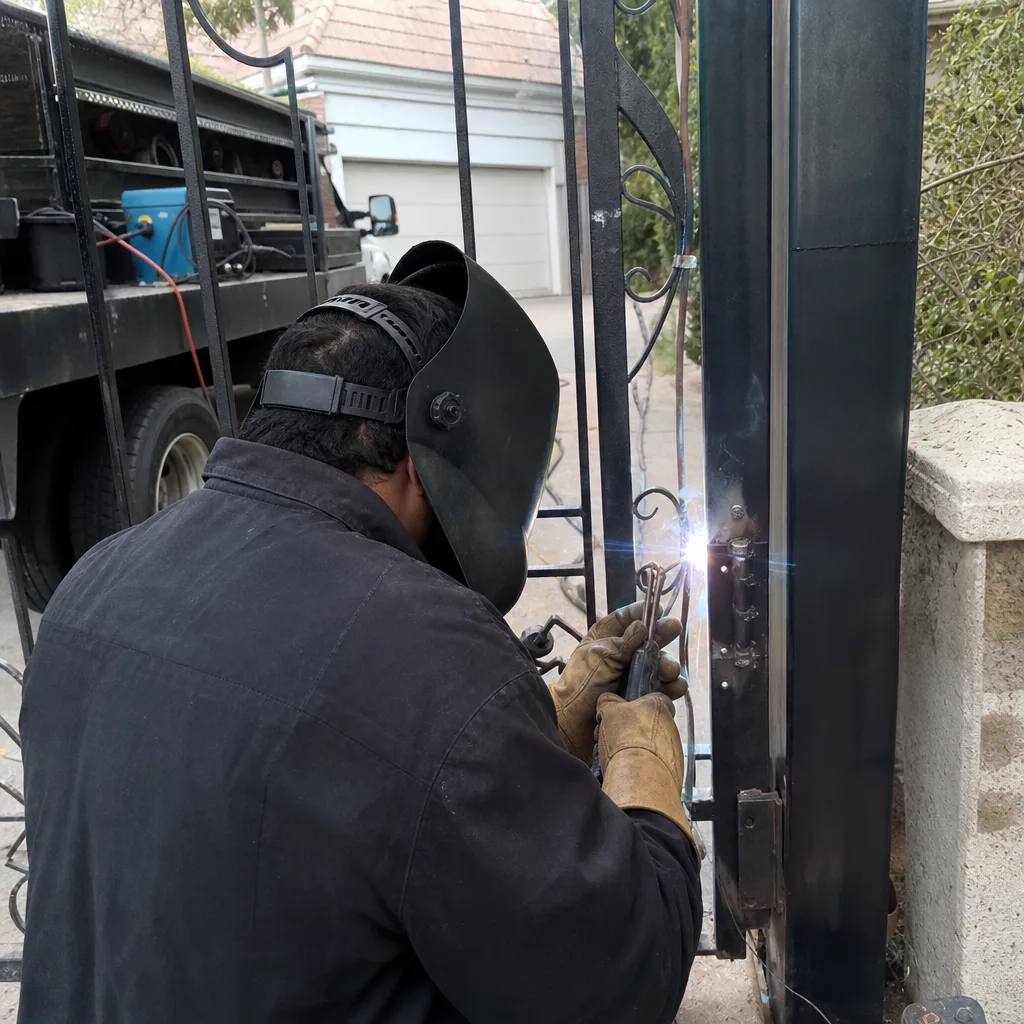
Garland sits on expansive clay soil, the notorious North Texas soil type that swells when wet and shrinks when dry. A long hot summer pulls moisture out of the ground. The soil contracts. Gate posts buried in that soil shift slightly, moving out of plumb. By October, the ground is still dry and the posts are still in their shifted positions. By November, the first serious cold fronts arrive, the ground hardens, and once the soil locks, the posts are fixed in place until spring.
That makes October and early November the only practical window to re-align gate posts that shifted over the summer. It’s not hyperbole: once the ground freezes or hardens, resetting a post requires either waiting for spring or breaking the soil mechanically, which is more invasive and more expensive.
The signs that a post has shifted enough to matter:
- The gate drags across the ground at one corner when it didn’t in May.
- The latch no longer lines up with the striker plate, even though the gate still closes.
- You notice a gap opening between the post and the surrounding concrete or soil.
- The gate begins to swing or slide slightly after the motor stops, a sign that the post is no longer providing a rigid anchor.
For swing gates, a shifted post throws the geometry off. Hinges that were level in April are now fighting each other, and the load transfers unevenly. For slide gates, a shifted track post can cause the gate to bind halfway through travel, which overloads the operator. Both conditions accelerate wear exponentially.
If you do one intentional thing for your gate this year, make it the October post check. It takes fifteen minutes and catches the slow drift before it becomes a repair. Here’s the process we recommend:
- Use a 4-foot level against each post, checking both planes: front-to-back and side-to-side.
- Note any reading more than 1/4 inch out of plumb over the length of the level.
- Measure the gap at the gate’s latch point and compare it to the previous season’s measurement, if you have one.
- Take a photo of the post base with a ruler placed against it, so next year’s check has a reference point.
- If a post is visibly out of alignment, call a technician before Thanksgiving. Resetting a post in frozen ground doubles the labor cost.
We’ve reset posts in Garland that had drifted three inches out of plumb over two summers. The owners had noticed the gate was “a little sticky” but hadn’t connected it to soil movement. In every case, the fix was less expensive before the ground locked. For more on post and structural work, see our Gate Installation in Garland page, which covers when a reset is enough versus when full replacement makes more sense.
Winter (December-February): Freeze Protocols and Hydraulic Systems
Garland winters are deceptive. The average December day is mild, and then a polar vortex drops temperatures into the teens for three days, as it did in February 2021 and again in December 2022. The freeze pattern matters because it produces two distinct failure categories: mechanical failures from expanding ice and water, and operational failures from hydraulic fluid that has thickened past its design tolerance.
Hydraulic gate operators have fluid reservoirs. When the ambient temperature drops below about 20°F, the fluid becomes more viscous, and the gate moves slower. This is normal and reverses when temperatures rise. But if the fluid is old or contaminated, the cold can push it past the point where the system can build adequate operating pressure. The gate will move partway, stop, and require a manual release.
The freeze-specific checks we recommend in Garland, especially before a forecast cold snap:
- Inspect the operator reservoir for condensation. Water in hydraulic fluid freezes at higher temperatures than the fluid itself. Ice crystals in the system cause jerky operation and can score internal components permanently.
- Make sure the manual release works before you need it. If the gate loses power during a freeze, you need to know you can open it by hand. Test the release handle or key once in November and once in January.
- Clear the area around the gate base of leaves and debris before a freeze. Debris traps moisture. Moisture freezes. Ice pushes against posts and hinges with enormous force.
- After a hard freeze, inspect the gate posts and hinge areas for new cracks or movement. The ground expands as it freezes. The same post that was perfectly aligned in October can shift again by February.
- Verify photoeye alignment. A photoeye is the infrared beam that stops the gate if something crosses the path. Over the winter, the brackets that hold the photoeyes can shift slightly from ground movement or casual contact with a lawnmower or car bumper. A misaligned photoeye causes the gate to reverse mid-cycle or refuse to close. Checking alignment takes ten minutes with a level and a visual sighting.
- Test battery backup load capacity. If your operator has a battery backup, spring is the time to verify it can actually move the gate under load, not just power the control board. We see batteries that test fine on a multimeter but fail the moment the gate motor draws starting current. The only real test is cycling the gate on battery power alone.
- Inspect lightning protection, if installed. A growing number of Garland gate operators have surge suppressors on the incoming power and the low-voltage control loop. These are sacrificial devices; after a lightning event, they may have already done their job and need replacement. If your system had a surge suppressor installed in a previous year, check its indicator light or have a technician test it each spring.
- Check all ground connections. Gate operators and access control keyboards rely on solid grounding for both safety and electrical noise rejection. Ground lugs corrode over winter. A loose or corroded ground creates intermittent faults that are nearly impossible to diagnose without a meter.
- Take five photos from fixed angles. Full gate front, full gate back, hinge or track close-up, operator housing interior, and post base at ground level. Stand in the same position each time. Use a reference mark if needed.
- Note three measurements in a running document. Gate clearance at the latch point, the post plumb reading from a level, and the month’s battery test result. Three numbers. Ten minutes.
- Date the photos and store them in one folder. When something eventually fails, the photos form the timeline that shows exactly when the drift, corrosion, or degradation started.
- Bring the log to any service visit. A technician who sees the last eight quarterly photos can diagnose faster and quote more accurately than one working from a single point-in-time observation.
- Capacitors on slide gate operators. Heat degrades the electrolyte. Symptom: slow starts, humming, afternoon laboring.
- Control boards in LiftMaster, FAAC, BFT, and Linear operators. Symptom: random operation, unresponsive remotes, mid-travel reversals.
- Ventilation fans that stopped running. Symptom: the housing is too hot to touch in late afternoon, and the gate shuts down after several cycles.
- Shifted posts on both swing and slide gates. Cause: summer soil shrinkage. Symptom: latch misalignment, dragging, gate binding.
- Welds under stress from misaligned posts. The weld isn’t failing; the movement around it is concentrating the load.
- Track and roller wear accelerated by a gate that’s been running just slightly out of alignment since July.
- Hydraulic fluid thickening in cold snaps. Symptom: gate slows dramatically or stops mid-travel below 25°F.
- Moisture inside operator housings causing corrosion blooms and intermittent shorts. Symptom: erratic behavior during and after freezes.
- Post movement from frozen ground expansion. Symptom: new hinge stress appearing weeks after the freeze.
- Photoeye misalignment from winter ground movement. Symptom: gate reverses or refuses to close.
- Battery backups that can’t hold load after a winter of cold-weather cycling. Symptom: backup works for the control board but not the motor.
- Failed surge suppressors from prior-year lightning. Symptom: no symptom until the next surge, which destroys the board.
- Lubricating a hot track in August. Lubricant applied when the metal is at maximum thermal expansion locks in alignment that will shift again when the metal contracts. Lubricate in the early morning during the summer, or wait for fall.
- Ignoring a slow-starting gate in July. A capacitor that’s degrading will eventually take out the motor windings. The $40 part becomes a $1,500 operator replacement. The symptom is the warning; don’t wait for failure.
- Skipping the fall post check because the gate “still works.” Post drift gets worse every summer and the ground locks every winter. Miss the fall window and the repair gets meaningfully more expensive.
- Testing a battery with a multimeter and calling it good. Voltage is not the same as load capacity. The only real test is cycling the gate on battery power alone at the start of storm season.
- Doing winter repairs without a post-freeze inspection. The freeze causes the movement; the movement causes the spring hinge failure. Inspect the posts in February, not just the operator.
- Replacing an entire gate system instead of documenting what’s been adjusted. When a technician leaves without a written record of what was changed, the next technician has to rediscover the problem. That’s how one stuck gate becomes five service calls.
The post-freeze inspection is the one most Garland homeowners skip, and it’s the one that prevents the following spring’s hinge failure. Here’s the pattern: winter ground expansion pushes a post slightly out of alignment. The hinges, now misaligned by just a few degrees, begin wearing unevenly. By May, one hinge has galled, and the other has stretched its bolt holes. The failure happens in the spring, but the cause happened in February. A fifteen-minute inspection in the week after a hard freeze catches it.
Winter also stresses gate electronics in a way summer doesn’t. Cold snaps cause condensation inside operator housings. That’s not a slow-degradation problem; it’s a short-circuit problem. If your gate acts erratically during or immediately after a cold spell, a moisture inspection is the first diagnostic step. We photograph the inside of every operator housing we open in winter, and rust bloom on connectors is one of the most common findings.
Spring (March-May): Storm Prep, Photoeyes, and Battery Backup
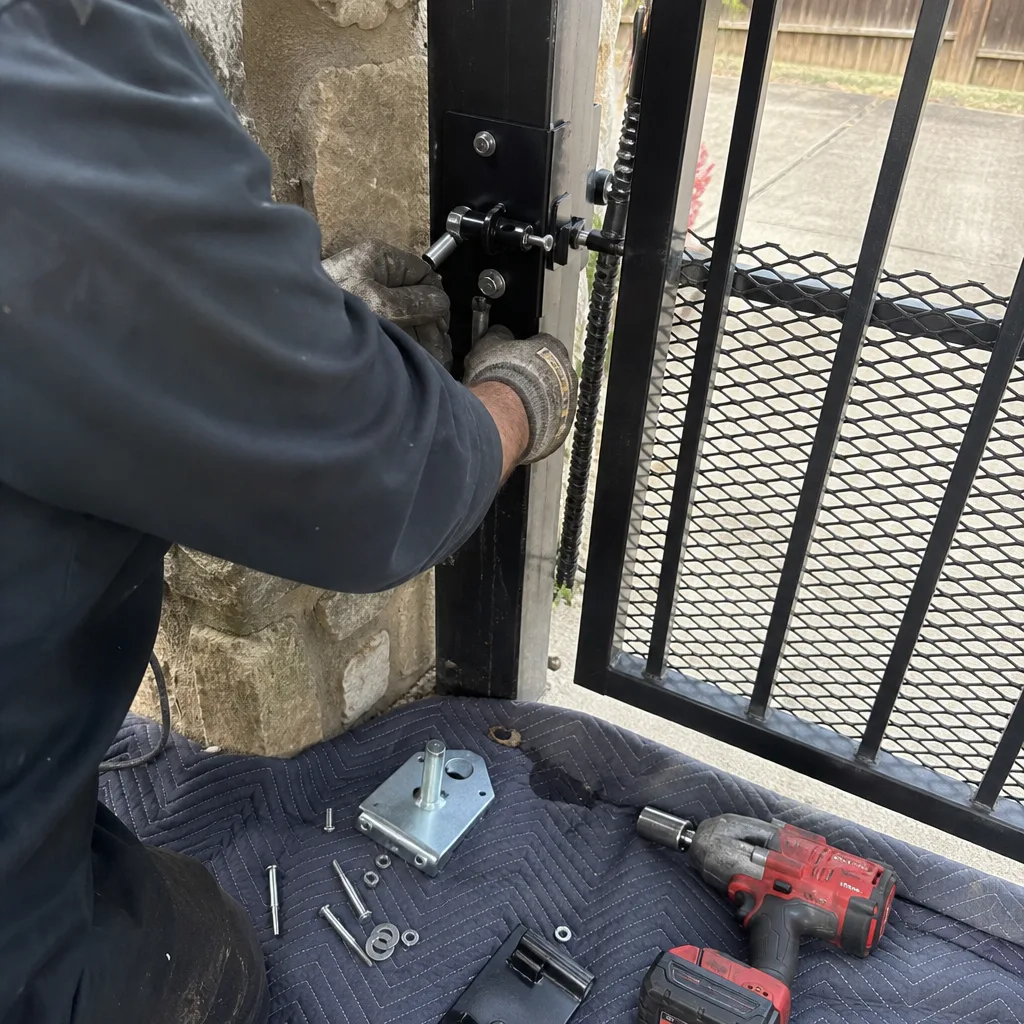
Spring in Garland means storm season. Severe thunderstorms arrive with regularity from late March through May, bringing lightning, hail, and high winds. The gate-specific preparation is different from what you’d do for your house. A gate is a metal structure in an open area, often the tallest thing in the front yard, and it’s connected to low-voltage control wiring that runs back to your electrical panel. Lightning-induced voltage spikes travel along that wiring, and the components they destroy are the control board, the transformer, and the photoeye receivers.
The spring checklist we recommend in Garland:
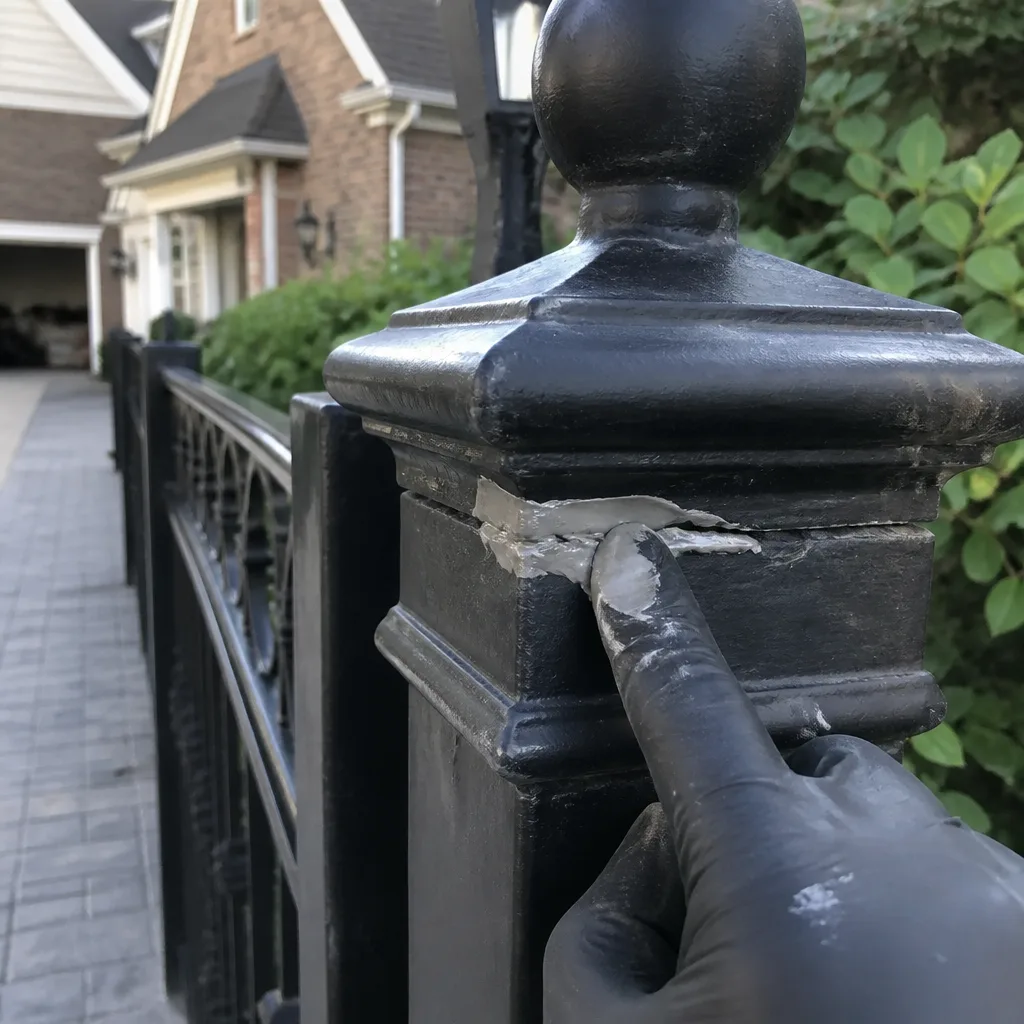
This is also the season for hinge inspection on swing gates. The winter freeze cycle puts the most stress on hinge metal. Look for powder coating that’s cracked at the hinge edges, hairline cracks at weld points, or a gate that sits visibly lower on one side. A hinge that fails in May was working hard all winter.
How to Build a Seasonal Gate Log That Shows Degradation Over Time
The most underused tool in residential gate care is a consistent photographic record. Most homeowners photograph their gate when something breaks, which captures the failure but not the events leading up to it. A gate log is different: four photos a year, taken from the same angles, on the same dates, regardless of whether anything seems wrong. Over two years, that log becomes the diagnostic record that makes future failures obvious and fixable before they become expensive.
The method is simple and takes fifteen minutes per quarter:
This is the same photographic-documentation approach we use on every Vance Gate Repair visit. The habit came from Adrian Vance’s commercial access-control work starting in 2014, where sites required a documented paper trail for every adjustment, every part number, and every limit-switch change. We bring the same discipline to residential gates in Garland. Under Haven Standard Clause 4 (Evidence on every job), every visit includes a documented photo record at no additional charge, showing what was found, what was adjusted, and what was installed. You keep a copy; we file a copy in the job record. If you build your own seasonal log, it dovetails perfectly with the record we leave behind. Explore more guides & resources to keep your gate maintenance on track.
Which Components Fail in Which Season in Garland
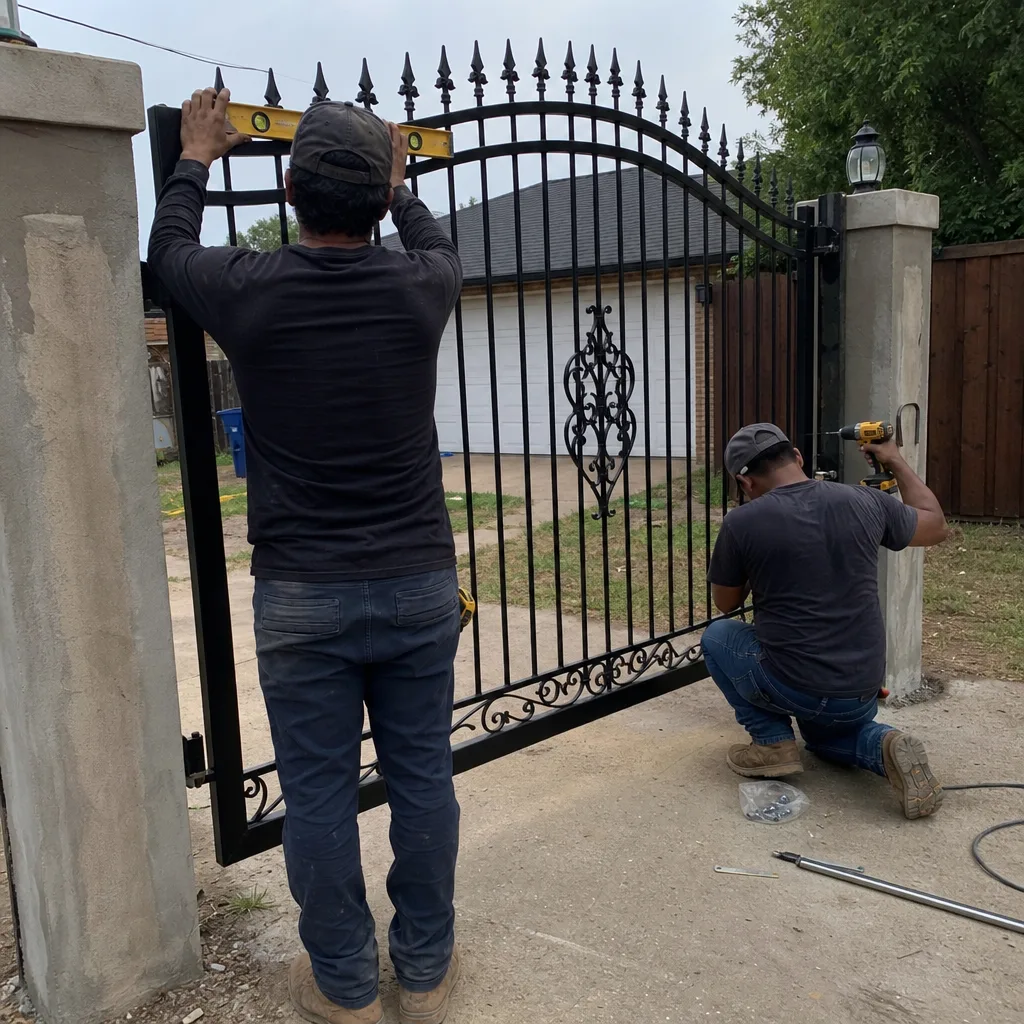
The seasonal pattern is reliable enough that we can map it year after year. Here’s what we expect to see on service calls in Garland, and when:
Summer failure pattern
Fall failure pattern
Winter failure pattern
Spring failure pattern
Common Mistakes to Avoid
When to Call a Professional
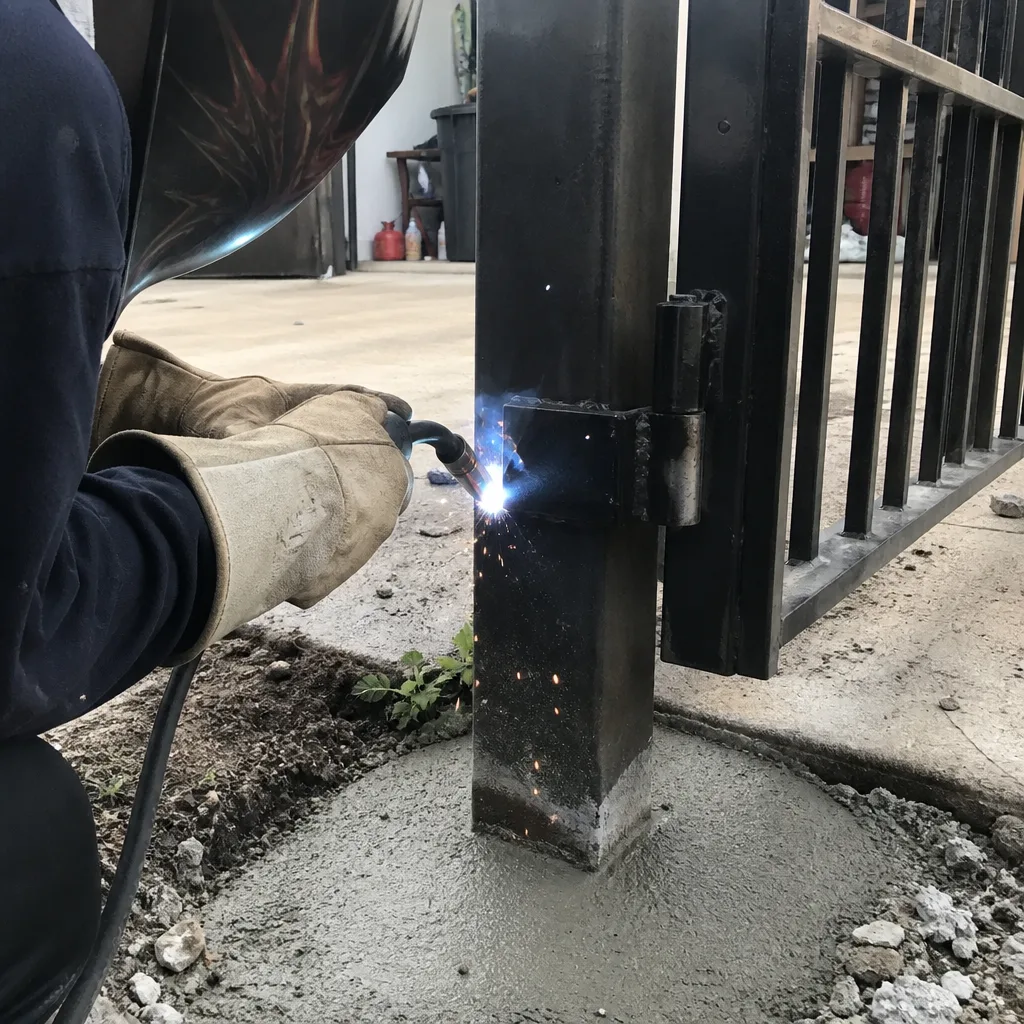
Some seasonal checks you can do yourself: the level against the post, the visual photoeye sighting, the morning track lubrication. But there are situations where a professional is the right call. If the gate is binding and you hear a grinding noise from the operator, there’s likely a mechanical alignment issue that requires tools and a lift, not adjustment. If the operator housing shows signs of moisture or corrosion, opening it and testing voltage without proper training is a genuine electrical hazard. And if you’re dealing with a spring-loaded gate that’s visibly off-balance, the spring under tension can cause serious injury if mishandled. High-tension springs and hinges on gates are dangerous under load; this is not a place for DIY experimentation. We also recommend calling for any gate where the post has shifted more than half an inch out of plumb, since that’s beyond what most homeowners can fix without specialized equipment. Vance Gate Repair Garland offers free estimates in Garland. We’ll inspect the gate, hand you a written price, and document what we find, whether or not you hire us. Call (469) 273-6254 for a free estimate.
Frequently Asked Questions
Seasonal gate maintenance in Garland typically runs $95 to $240 per visit depending on the scope: a basic quarterly inspection with lubrication and photoeye alignment starts around $95, while a full seasonal service that includes battery load testing, post plumb measurement, and a written condition report runs $150 to $240. We provide a written price before any work starts, so you know the number before the first tool comes out. Call (469) 273-6254 for an exact quote, which is free.
The signs of post shift are a gate that drags at one corner, a latch that no longer lines up with the striker plate, a growing gap between the post and the surrounding concrete or soil, and a gate that drifts slightly after the motor stops. In Garland’s expansive clay soil, post shift is a recurring seasonal issue, not a one-time defect. The October-November window is the best time to re-align before the ground hardens.
Yes. Sustained ambient temperatures above 100°F push internal operator temperatures past 140°F, which accelerates degradation of electrolytic capacitors and eventually damages control boards. The warning signs are slow starts, a humming motor before movement, and afternoon-specific laboring. Caught early, the fix is a $40 to $120 capacitor replacement; ignored, it becomes a $1,100 to $2,700 operator replacement.
Hydraulic operators need the fluid checked for water contamination before cold weather. Water in hydraulic fluid freezes at a higher temperature than the fluid itself, causing jerky operation and potential internal scoring during a Garland freeze. Test the manual release once in November and once in January so you know you can open the gate by hand if power goes out.
A misaligned photoeye causes the gate to reverse mid-cycle or refuse to close, even when the path is clear. Visually inspect both photoeye units: each should be aimed directly at the receiver lens across the gate opening. If one bracket has shifted even slightly from ground movement, the beam will miss its target. Alignment takes ten minutes with a level and a visual sighting.
Not necessarily. Many operator issues that look like “going bad” are actually alignment, lubrication, or battery problems that a repair can fix at a fraction of the replacement cost. If you’ve been seeing intermittent behavior, have a technician diagnose the specific cause before you order a new operator. Gate Repair in Garland is our specialty, and the diagnosis comes with a written price up front. Call (469) 273-6254 to schedule.
The Bottom Line
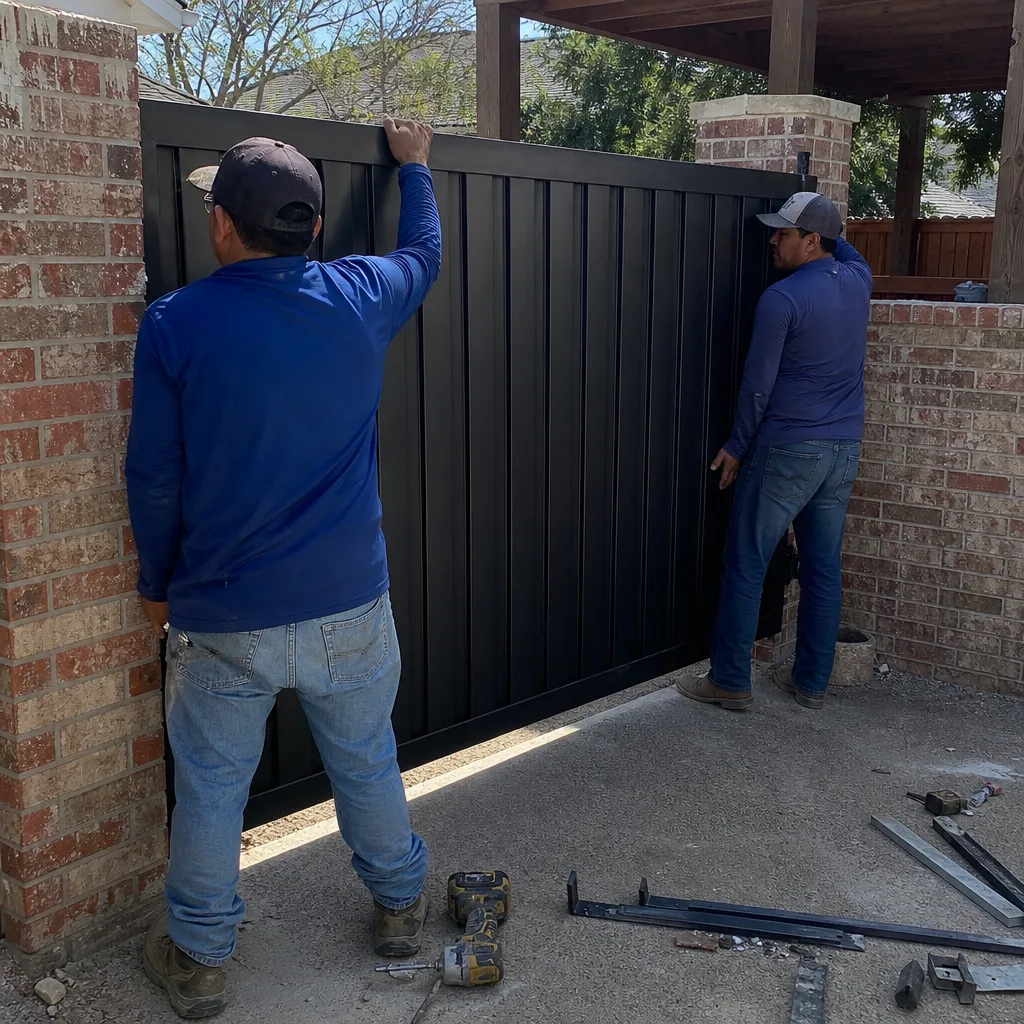
Garland’s climate doesn’t stress gates uniformly. Summer kills electronics. Fall is your soil-realignment window. Winter attacks mechanical anchors and hydraulics. Spring brings storm damage and backup battery failures. If you adopt a quarterly routine synchronized to those seasons, you’ll catch most failures in their early, inexpensive phases. If you don’t, one season’s neglect becomes the next season’s repair. The most important tool you can bring to this routine is a camera and a consistent angle: document the gate four times a year, and you’ll see degradation before it becomes failure. That’s the same documentation habit we bring to every job at Vance Gate Repair Garland. For more on our approach, start at the Vance Gate Repair Garland home page, or call (469) 273-6254 for a free estimate on any gate work in Garland.
Written by Adrian Vance, Owner at Vance Gate Repair Garland, serving Garland since 2014.